01· Business Context
1. Understand the Business Context
I aligned the product scope with business and operational requirements. The focus was to create a complete IFG Life experience covering product discovery, purchase, policy management, claims, and emergency support.
- Product Scope Alignment: Defining core touchpoints across the full lifecycle of IFG Life insurance products.
- Operational Integration: Aligning digital self-service capabilities with insurance underwriting, policy registries, and medical provider networks.
- End-to-End Coverage: Unifying discovery, purchase, active policy control, cashless hospital admission, claims, and emergency assistance into a cohesive mobile experience.
OutputProject scope, business goals, user journeys, and key dependencies.
02· Exploratory Research
2. Conduct Exploratory Research
We interviewed five insurance users with different levels of experience. The research covered their behavior from discovering insurance to managing active policies and submitting claims.
✦ Two Core User Segments
- Newcomers: Needed guidance, simple plain-language terminology, and curated product recommendations.
- Experienced Users: Needed transparency, faster direct access, and more control over their policies.
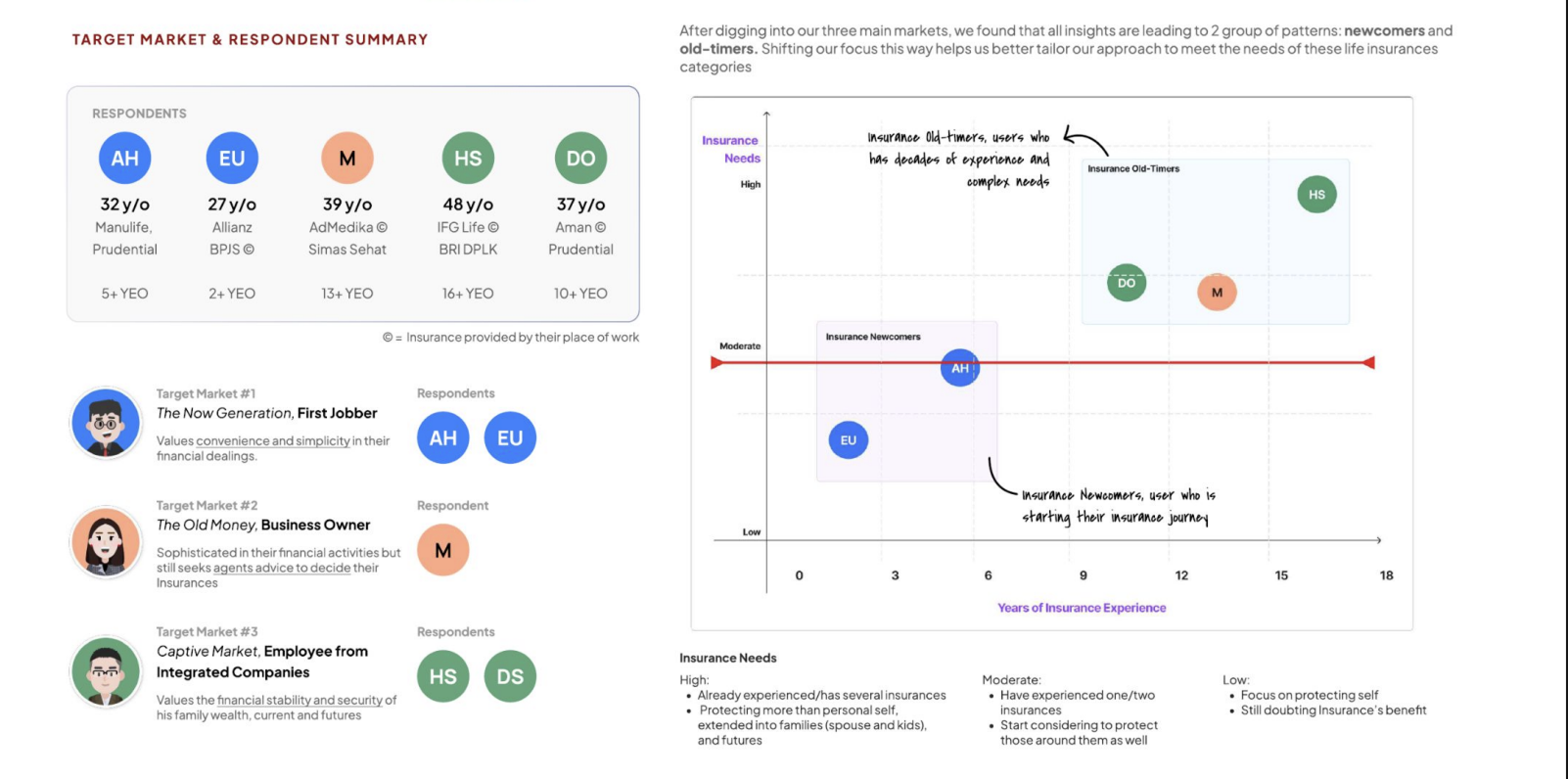
Target market breakdown and respondent summary across 5 interviewed insurance users (AH, EU, M, HS, DO) across various life stages and insurance tenures.
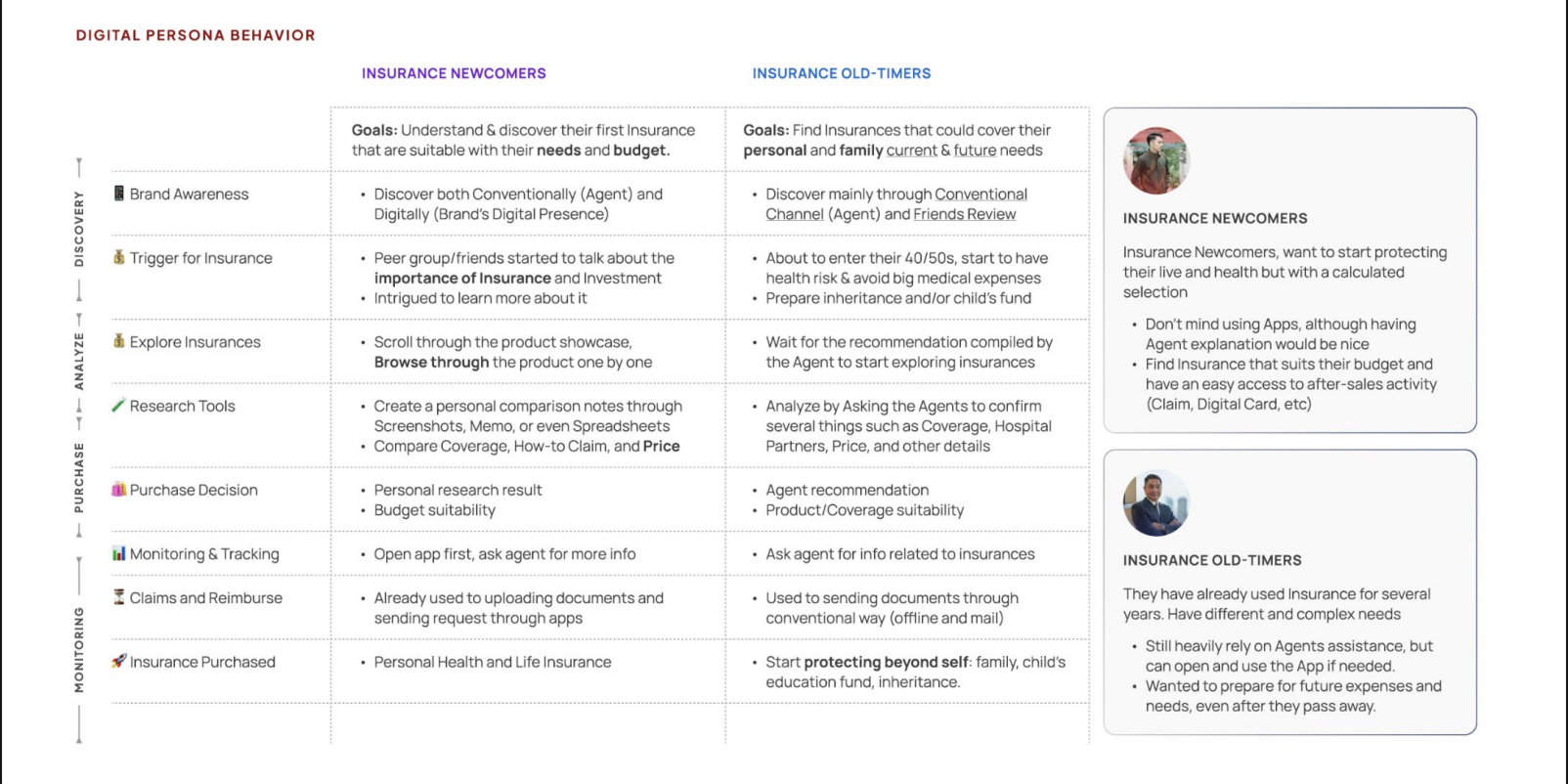
Digital persona behavior comparing Insurance Newcomers vs. Insurance Old-Timers across discovery, analysis, purchase, and active policy monitoring.
OutputUser segments, behavioral patterns, needs, and pain points.
03· Journey Mapping
3. Map the Customer Journey
I mapped the insurance journey across seven stages to identify friction gaps between user expectations, digital touchpoints, agent support, and operational processes:
- 1
1. Product AwarenessInitial brand and protection discovery via digital marketing, word-of-mouth, or conventional agent outreach.
- 2
2. Product ExplorationBrowsing IFG Life plans (e.g. LifeSAVER, Life Cover), reading benefit highlights, and checking facility coverage.
- 3
3. Product ComparisonEvaluating coverage tiers, sum assured limits, premium periods, and exclusions side-by-side.
- 4
4. Purchase and ScreeningSelecting plan configurations, auto-filling profile data, completing health screening questionnaires, and payment checkout.
- 5
5. Policy MonitoringAccessing digital e-cards, viewing real-time benefit limits, checking covered dependents, and monitoring payment status.
- 6
6. Benefit Usage and ClaimsShowing instant cashless QR codes at partner hospitals or submitting digital reimbursement claims with required documents.
- 7
7. Retention or CancellationUpgrading policy limits, adjusting contribution periods, auto-debit renewal management, or policy changes.
OutputEnd-to-end customer journey and opportunity map.
04· Problem Definition
4. Define the Core Problems
The research was translated into four core design problems:
“How might we simplify insurance decisions while giving users confidence before and after purchasing a policy?”
- Product Selection: Users struggled to identify suitable products matching their specific life stage and budget.
- Terminology Barrier: Complex insurance terms and opaque clauses made cross-comparison difficult.
- Screening Friction: Long, intimidating forms and medical screening reduced completion confidence and drove drop-offs.
- Tracking Blindspots: Policy benefits and claim progress were difficult to track after purchase without contacting agents.
OutputProblem statements and How Might We questions.
05· Opportunity Prioritization
5. Prioritize Opportunities
I prioritized ideas based on user value, business impact, and implementation feasibility:
✦ Highest-Priority Opportunities (MVP Direction)
Lower-priority concepts, such as interactive simulations and complex offboarding experiences, were placed in the future roadmap.
- Guided product exploration & life-stage recommendations.
- Contextual terminology support & plain-language micro-copy.
- Simplified forms with progressive health screening.
- Real-time policy and benefit balance tracking.
- Guided claims submission with visible audit trail status.
- Direct 1-tap emergency access & nearby hospital navigation.
OutputPrioritized feature backlog and MVP direction.
06· Experience Architecture
6. Define the Experience Architecture
I structured the IFG Life experience into three main areas, where the active policy becomes the central entry point connecting all post-purchase actions:
- Explore: Discover, compare, and purchase insurance products.
- Manage: View active policies, track benefit balances, upgrade coverage, and submit claims.
- Emergency: Find nearby cashless hospitals and contact direct emergency support.
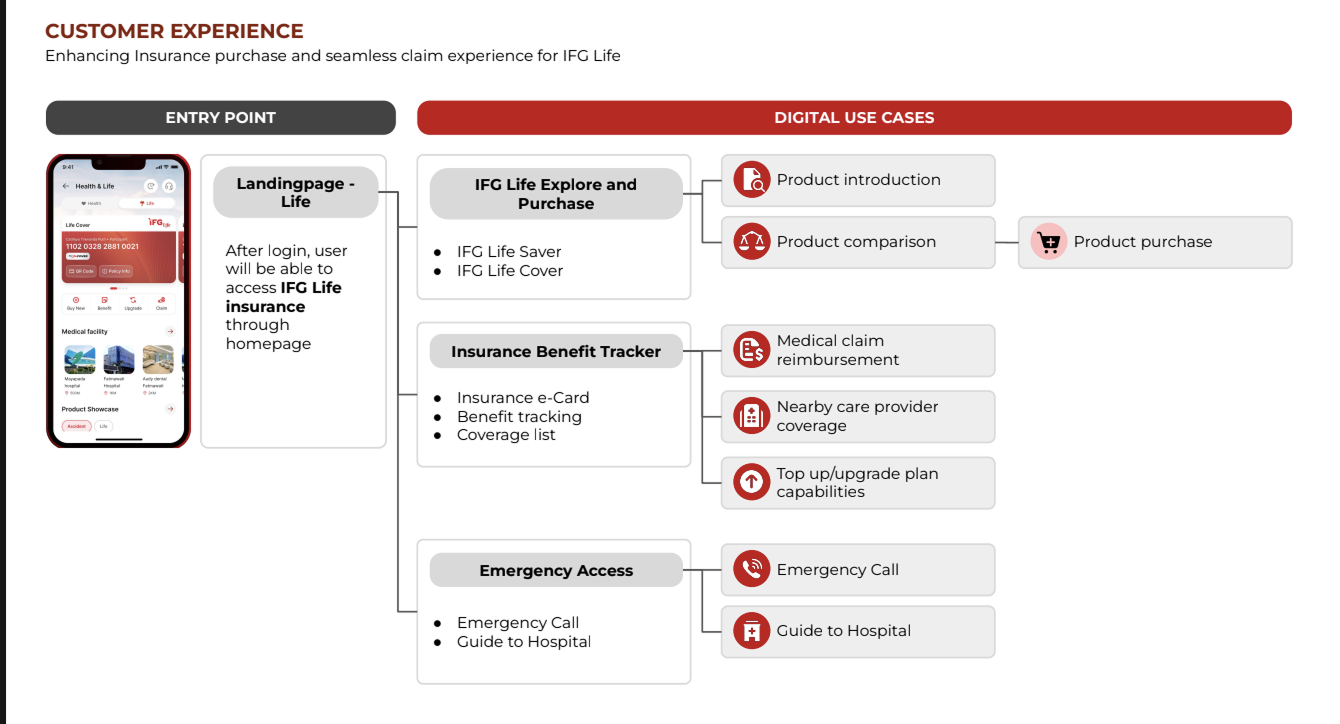
Customer experience architecture establishing the entry points and digital use cases connecting Explore & Purchase, Benefit Tracker, and Emergency Access.
OutputInformation architecture and navigation model.
07· Core User Flows
7. Design the Core User Flows
I designed six connected user flows covering the end-to-end insurance journey:
✦ Product Discovery
Homepage→
IFG Life landing page→
Product introduction→
Product comparison→
Product details
✦ Insurance Purchase
Product selection→
Coverage configuration→
Prefilled data→
Health screening→
Review→
Payment
✦ Policy Management
Policy dashboard→
Policy information→
Benefit balance→
Facility access→
Available actions
✦ Policy Upgrade
Current plan→
Upgrade options→
Benefit comparison→
Contribution summary→
Checkout
✦ Claim Submission
Claim center→
Document requirements→
Claim form→
Submission→
Status tracking
✦ Emergency Access
Emergency shortcut→
Service options→
Nearby hospitals→
Hospital details→
Direct call
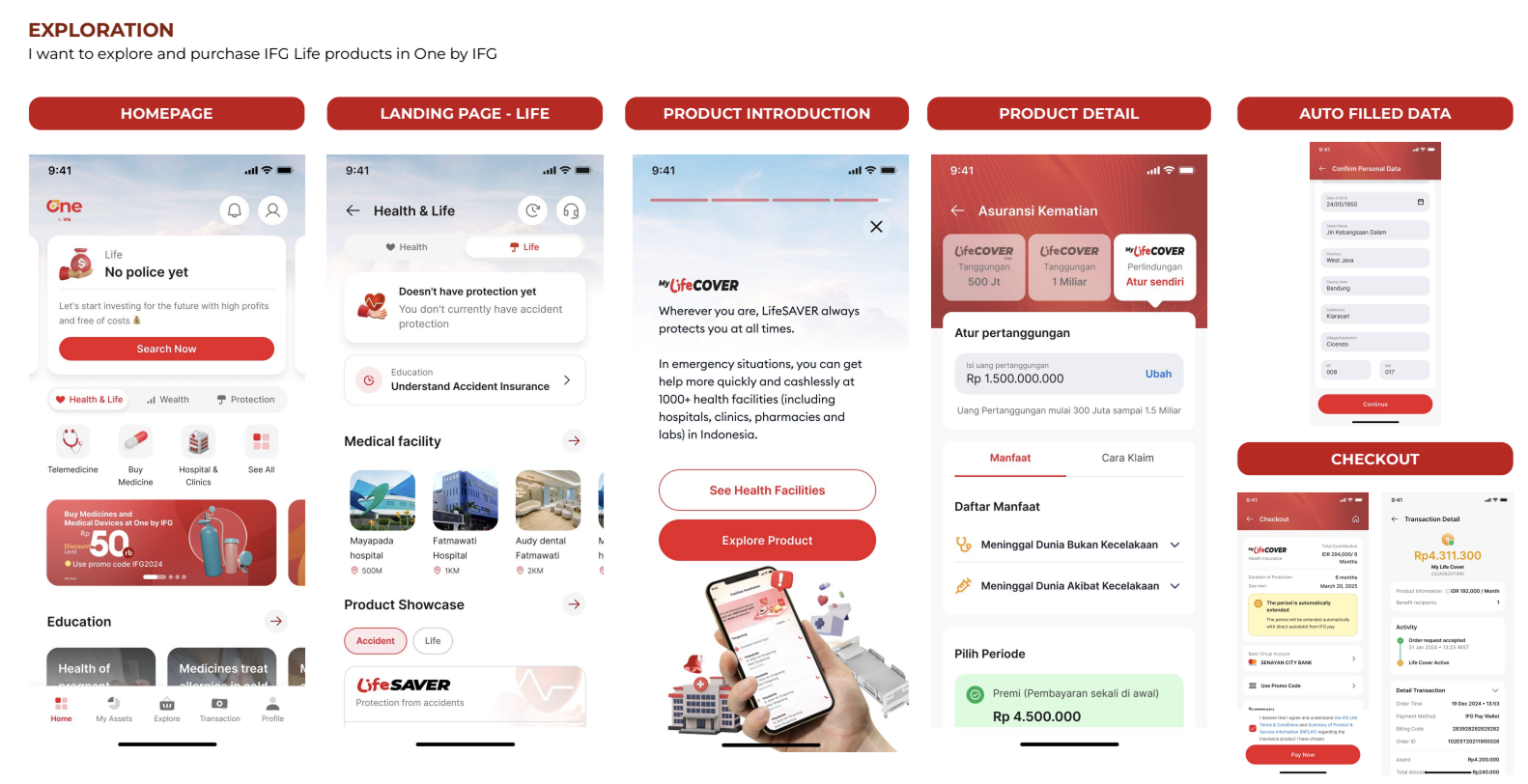
Exploration user flow: Homepage → Landing Page - Life → Product Introduction → Product Detail → Auto-filled Data → Checkout.
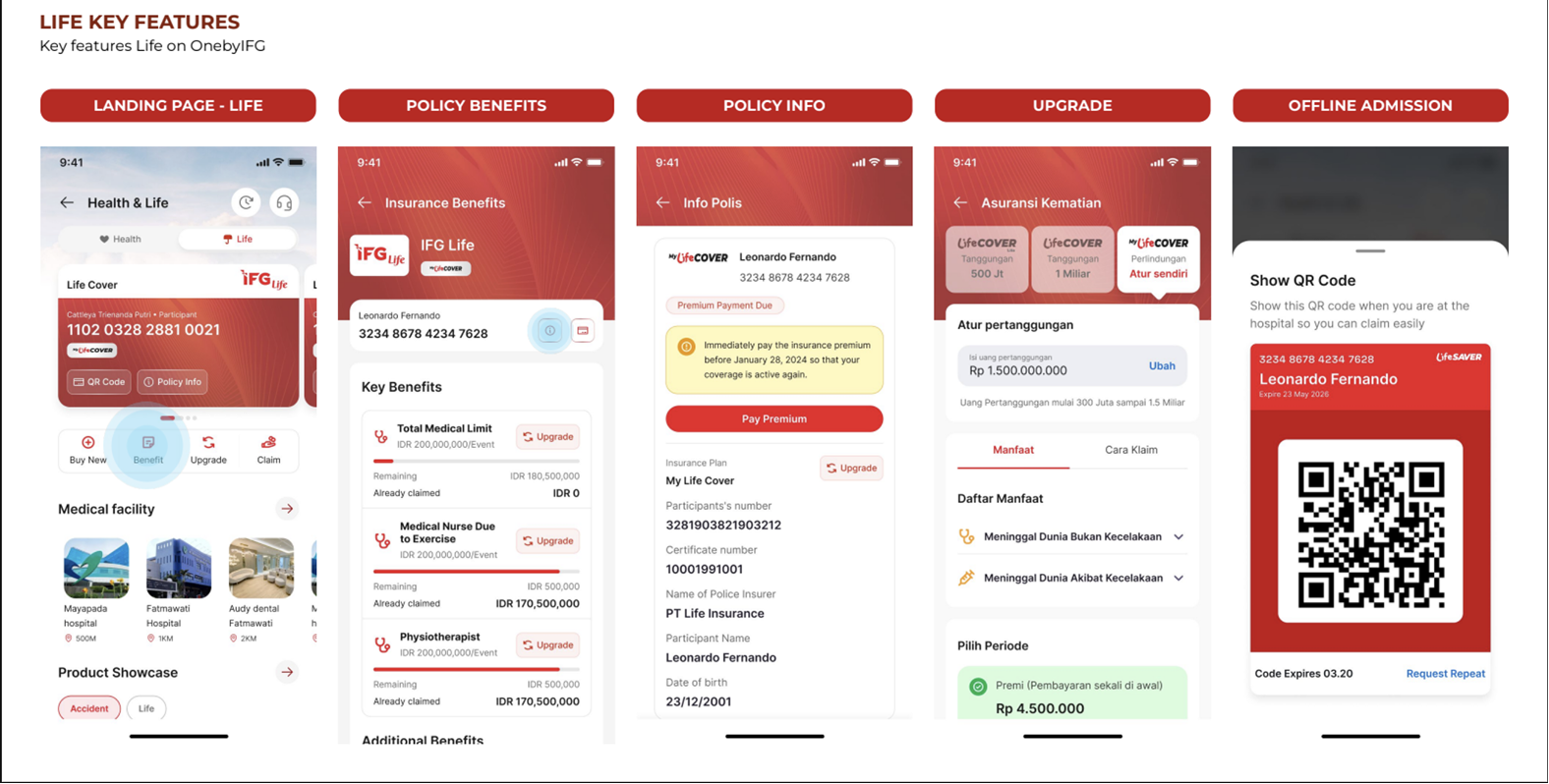
Life key features flow: Landing Page - Life → Policy Benefits → Policy Info → Upgrade → Offline Admission (QR Code).
OutputUser flows, wireframes, and edge-case considerations.
08· Interaction Design
8. Simplify Complex Interactions
The goal was not only to reduce steps, but also to reduce uncertainty at each step. I reduced complexity through seven core interaction patterns:
- Progressive Disclosure: Breaking multi-layered policy configurations into bite-sized, digestible steps.
- Prefilled Customer Information: Automatically fetching verified user profile data to eliminate redundant typing.
- Conditional Screening Questions: Dynamic logic showing health questions only when triggered by previous answers.
- Contextual Explanations: Plain-language in-line tooltips demystifying legal and medical clauses.
- Save-Draft Functionality: Enabling users to pause an application, consult family, and resume seamlessly.
- Clear Transaction Summaries: Total transparency in coverage sums, auto-debit terms, and renewal cycles.
- Visible Claim Status & Next Steps: Step-by-step audit trail eliminating guesswork during claim review.
OutputInteraction patterns and content hierarchy.
09· UI & Visual Design
9. Create the Visual Experience
I translated the approved flows into high-fidelity mobile interfaces using consistent components, spacing, typography, and interaction patterns. Critical actions such as claims, upgrades, and emergency support were given stronger visual priority than secondary content.
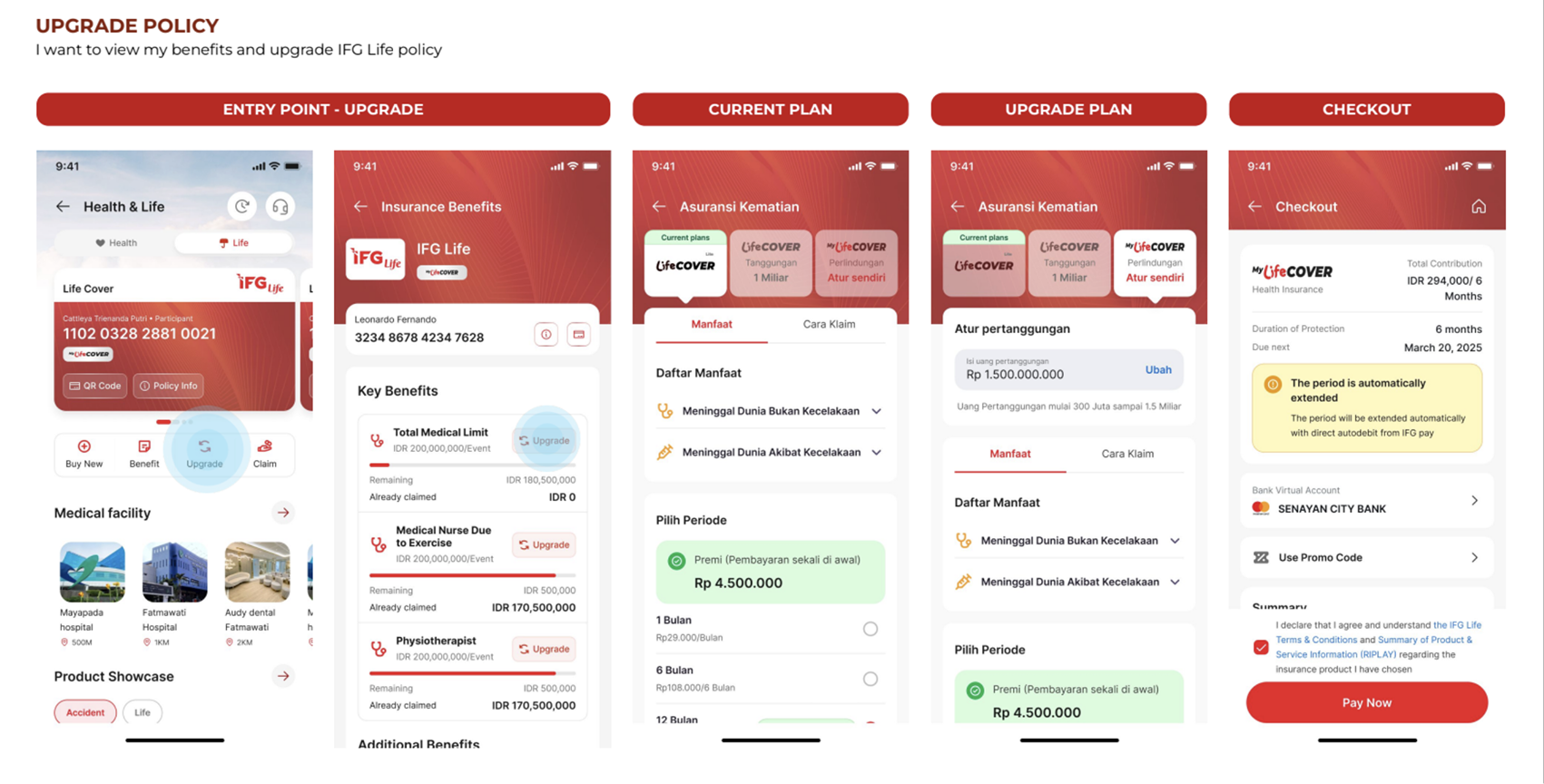
High-fidelity screens for Policy Upgrade: Entry point → Current plan view → Upgrade plan comparison → Contribution checkout.
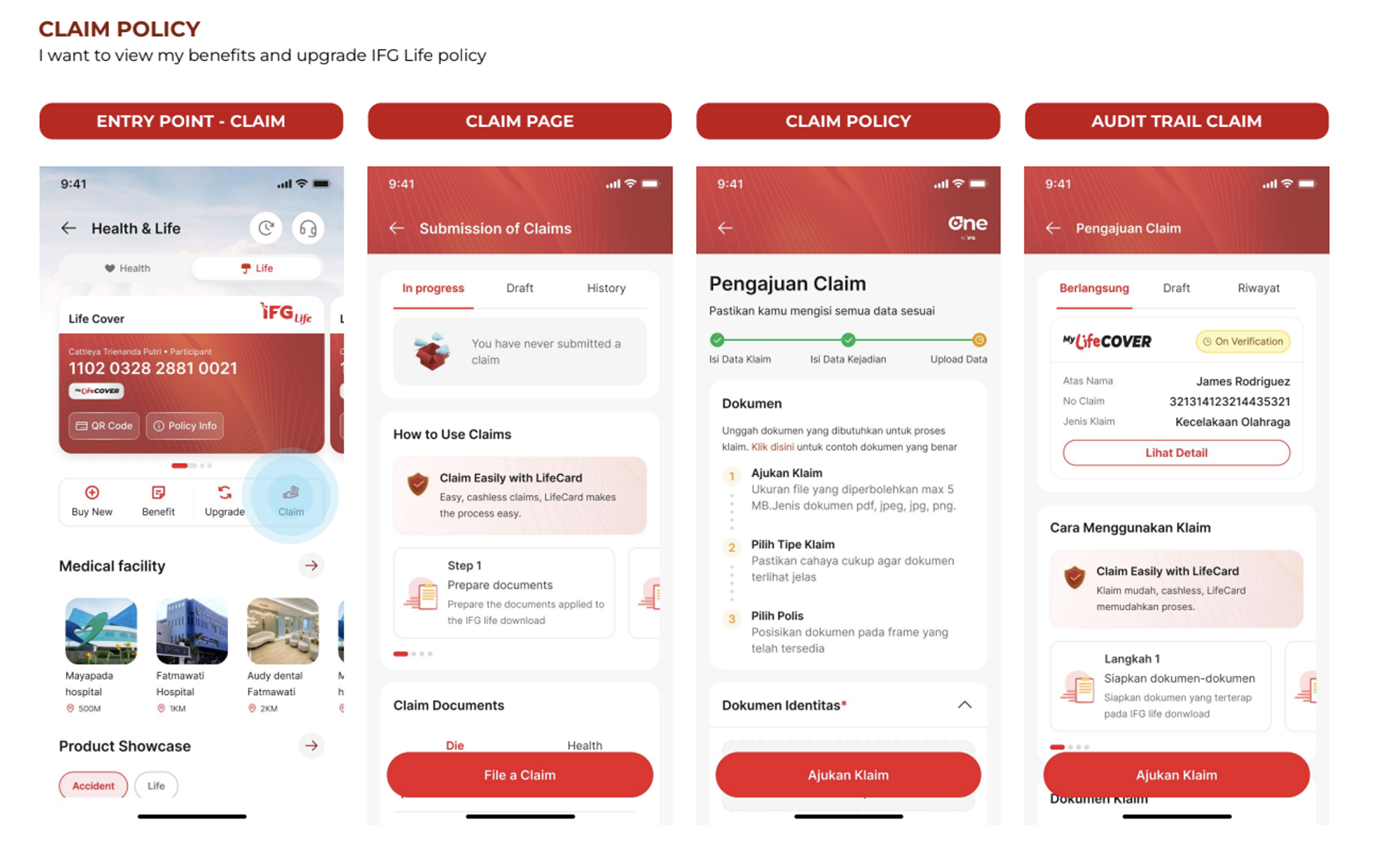
High-fidelity screens for Claim Submission: Entry point → Claim page overview → Interactive claim form → Audit trail verification status.
OutputHigh-fidelity screens and reusable UI patterns.
10· Prototyping
10. Build the Prototype
I connected the screens into three main prototype scenarios to review the complete journey with product and business stakeholders:
- Scenario 1: Exploring and purchasing an IFG Life product from discovery to payment confirmation.
- Scenario 2: Managing active benefits, upgrading policy coverage limits, and filing a digital reimbursement claim.
- Scenario 3: Locating nearby cashless partner hospitals via GPS and triggering direct emergency call support.
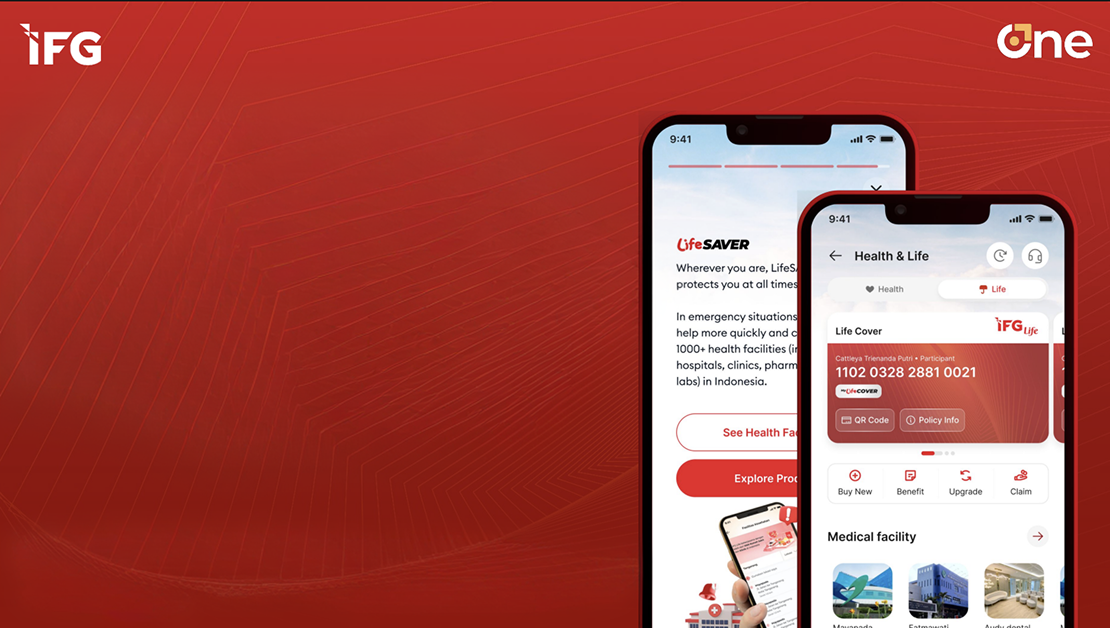
End-to-end interactive prototype unifying the digital insurance journey across all touchpoints.
OutputEnd-to-end interactive prototype.
11· Validation Framework
11. Validate the Experience
The recommended usability testing focused on six core validation benchmarks:
Note: The source document does not include formal testing results, so performance improvements should only be added when verified data is available.
- Product Comprehension: Assessing how clearly users grasp coverage scope, limits, and policy exclusions.
- Purchase & Screening Completion: Measuring completion rates and friction points across health questionnaires.
- Policy Benefit Discoverability: Evaluating ease of finding remaining balances, coverage details, and e-cards.
- Claim Submission Success: Testing self-service document uploading and form submission velocity.
- Claim Status Understanding: Validating clarity of verification milestones in the audit trail tracker.
- Time to Reach Emergency Support: Measuring the duration from app open to initiating emergency contact.
OutputValidation plan, testing scenarios, and success metrics.
12· Engineering Handoff
12. Prepare for Implementation
I documented the main flows, interaction logic, screen states, and dependencies for engineering handoff. I also identified cases requiring coordination with agents, operations, compliance, payment systems, hospitals, and claim-processing services.
- Design Specifications: Comprehensive interaction logic, error states, form validations, and reusable design tokens.
- System Dependencies: Documented API requirements for payment gateways, hospital QR validation, and underwriting backends.
- Cross-Functional Coordination: Handover guidelines bridging digital actions with back-office claim processors, compliance, and agent workflows.
OutputDesign specifications, prototype, implementation notes, and measurement plan.
Summary· Synthesis
Process Summary
From Exploratory Research to End-to-End Insurance Delivery
I translated exploratory research into a structured insurance experience, from identifying user segments and mapping the journey to prioritizing opportunities, designing critical flows, and delivering an end-to-end prototype for IFG Life.